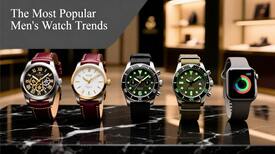
How the Most Popular Men’s Watch Trends Have Changed
The world of watches never stands still. What men wore on their wrists fifty years ago looks nothing like what they wear today. The most popular men’s watch styles have shifted dramatically over the decades, reflecting changes in technology, fashion, and lifestyle. From chunky digital displays to sleek minimalist designs, each era brought something new to the table. Understanding these shifts helps you appreciate where we are now and where watch trends might head next.
The Golden Age of Dress Watches
In the 1950s and 1960s, men required a watch for but one purpose: elegance. Thin cases, leather straps, and uncluttered dials were in vogue. One respectable gentleman would possess one great watch, wearing it at all times. These examples were simple yet magnificently wrought.
The assumption was that brands like Omega, Longines, and Jaeger would concentrate on slim profiles to slide easily under a shirt cuff. Gold and silver had been the favorite colors. Complications were few and far between. Most merely told the time and perhaps the date, which was still considered good enough.
The dress watch symbolized maturity. Young men received them as graduation gifts or even wedding presents. When you have one quality timepiece of measure and vision, it truly signifies you’ve made it.
How the Most Popular Men’s Watch Shifted to Bold and Sporty
The 1970s changed everything. Suddenly, big was better. Sport watches entered fashion. Divers, pilots, and those who’ve raced wanted watches that would accompany their adventures.
The Rolex Submariner and Omega Seamaster came to be known far and wide. They were characterized by larger cases, rotating bezels, and water resistance. Crafted tough. Men untouched by the ocean still wanted that rugged look on their wrist.
There was an overturning in the choice of metal—stainless steel replaced gold. Bracelet straps became prevalent, taking over from leather. The entire feel turned away from formalism toward functionality. This versatility allowed this to be worn with anything from a suit to jeans. This versatility mattered.
Chronographs are the beasts of their era. Extra dials and pushers give watches a far busier and more mechanical aesthetic, which men adored. It was like having a miniature machine on their wrist.
The Digital Revolution Takes Over
Enter quartz: The Japanese brands Seiko and Casio developed battery-operated watches that ran more accurately than conventional mechanical movements. And they were far cheaper to manufacture.
Everywhere there were digital displays in the late ’70s and ’80s: calculator watches. Watches with alarms and stopwatches. Some played basic games, apparently. The technology became the marketing gimmick.
Traditional Swiss watchmakers panicked. Many nearly went bankrupt. The ‘quartz crisis’ forced an industry to reform itself or lay claim to history. Some brands doubled down on luxury and craftsmanship. Others went with the new tech.
In 1983, Casio G-Shock arrived and changed casual watches for good. Near-indestructibility, along with a debt of features, appealed to the younger generation that wanted to steer clear of their fathers’ watches.
The Mechanical Renaissance
Intriguingly, the 1990s were the time when people started missing their mechanical watches, missing the craftsmanship, the sweeping second hand, and the innumerable connections to watchmaking culture.
Luxury mechanical watches became acclaimed for the second time. Brands that survived the quartz crisis found their resources anew. Collectors emerged who valued the handmade above the digital or the accurate.
This period also initiated a fashion for skeleton dials. Transparent-faced watches showing their inner workings grew immensely popular. Men wanted to see the gears turn.
Vintage timepieces also skyrocketed in value. Pieces from the 1960s and 1970s commanded premium prices at auctions. The old had become new once again.
The Oversized Era
The 2000s brought supersized watches. Case diameters jumped from 36 mm to 42 mm, then 44 mm, then even larger. Panerai led this charge with their bold, chunky designs.
Fashion watches joined the party. Brands like Diesel and Fossil offered massive timepieces at affordable prices. Bigger faces were easier to read. They also made a statement.
This trend peaked around 2010 to 2015. Watches became accessories as much as tools. Men coordinated them with outfits. Some owned dozens of watches for different occasions.
Smartwatches Enter the Game
Apple Watch launched in 2015 and split the market wide open. Suddenly watches could track your heart rate, show your texts, and play your music. Traditional watchmakers faced disruption again.
Younger buyers flocked to smartwatches. Fitness tracking became a key feature. The line between watch and wearable computer blurred completely.
Some predicted the end of traditional watches. That prediction proved wrong. Instead, the market simply expanded. Some men wear smartwatches for workouts and mechanical watches for dinners out.
Where We Stand Today
Current trends show interesting patterns. Smaller case sizes are returning. Many brands now offer 38mm to 40mm options, a return to classic proportions.
Minimalist designs sell well. Clean dials without date windows or extra complications appeal to modern tastes. Less is more again.
Vintage-inspired pieces dominate new releases. Brands dig into their archives for design cues. Colors from the 1970s pop up in current collections. Retro is in.
Sustainability matters more too. Buyers ask about materials and manufacturing practices. Some brands now use recycled metals and ocean plastics.
The most popular men’s watch today balances heritage with innovation. Men want quality that lasts. They want something with story and substance. Whether mechanical or digital, the best watches connect us to something larger than telling time. They mark moments. They become heirlooms. And they will keep evolving as tastes and technology change together.







Post Comment